
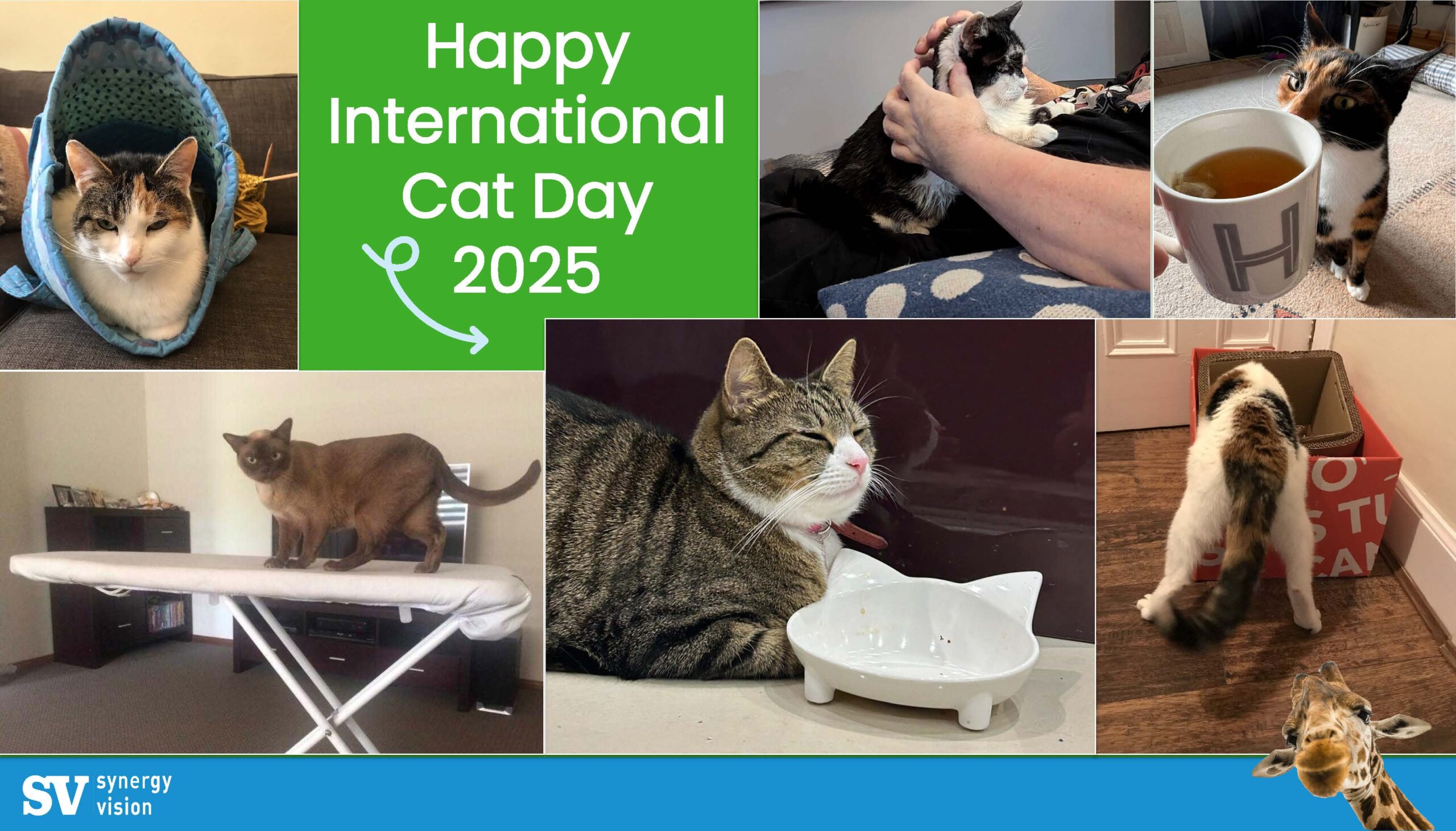
Today is a very special day for the cat friends among us: International Cat Day! And if you’re lucky enough to share your life with a cat (we don’t use the ‘own’ word around these parts), you know that harmonious partnership is achieved through taking the time to truly understand them. Because, let’s be honest: cats aren’t as mysterious as they like to think.
But they do present a range of challenges, just like any audience with a range of sometimes contradictory needs. Yes, we mean healthcare professionals (look at that slick transition). It might sound silly, but when we thought about the many Cats of SV, we couldn’t help but draw the parallels. And we ended up identifying 5 cat behaviours that actually tell us something about how we can make medical education more effective.
Read on for the rundown.
1. Make the audience feel special aka The ‘Chosen One’ Vibe
Cat behaviour: Cats often choose *their* person, seemingly singling them out for affection. They make you feel as if you’ve been granted a rare privilege.
HCP education takeaway: Relevance and personalization are key! Medical communications should feel crafted for the development opportunities of the individual or a clearly defined audience segment. When content is personalized, highly relevant, and directly addresses specific needs, concerns, or information gaps, it creates an immediate sense of value and makes the audience more receptive. It’s about showing you truly ‘see’ them, which makes them feel special.
2. Deliver content at the right place and right time aka ‘The Food Bowl’ Principle
Cat behaviour: A cat won’t eat from an empty bowl, or a dirty one, or if it’s in a scary spot. The food might be gourmet, but if the context is wrong, forget it.
HCP education takeaway: Consider channel, timing, format and context. Even the most interactive and interesting educational content will fall flat if it’s not on the channels your audience prefers, at a time they’re receptive, and in a format that’s easy to digest. The science is the foundation of ‘what’ we’re saying, but we go beyond to help consider how and where the content will be best expressed and received – be it a concise infographic on a mobile app, a short communication in a journal, or a quick-hit video on a social platform.
3. Take time to truly understand the audience, their habits, and their needs aka The ‘Cat Whisperer’ Approach
Cat behaviour: True cat lovers know their cat’s quirks, favourite nap spots and preferred toys – even their meows for different needs. This deep understanding allows for effective interaction.
HCP education: Turn audience insights into anticipated needs, not just reactions to them. When designing education, we need to act like ‘medcomms whisperers’, which requires synthesizing information from all angles:
- Developments in technological capabilities
- Evolutions in adult learning and behaviour change best practices
- Insights from advisory boards and KEE engagement initiatives
- Aha moments from ad hoc conversations
- Our own experience of what’s most effective.
All those factors help us key into the routines, information-seeking behaviours, pain points, motivations, and existing knowledge gaps of HCPs. Starting from a place of empathy and insight lets us anticipate HCP needs and craft messages that truly resonate, build trust, and drive desired actions.
4. Respect their autonomy aka The ‘My Rules’ Philosophy
Cat behaviour: Cats respond best to subtle invitations, not commands. They also have short attention spans for things they don’t care about.
HCP education: Respect your audience’s time and intelligence. In adult learning theory, self-directed learning is the most effective because, when people take responsibility for their own learning, they get more out of it. Education can’t be forced upon HCPs, rather it should be created from a user-centric place, to ensure it is accessible, digestible and actionable. Give HCPs the information that meets their learning and medical decision-making needs, and allow them to engage on their own terms. That’s it. That’s the approach that will foster a sense of control, which builds trust and learner loyalty over time.
5. Acknowledge uncertainty, then offer paths to clarity aka ‘The Calming Purr’ Effect
Cat behaviour: Cats often respond to distress with a nuanced understanding. They don’t pretend everything is perfect, but once they feel safe, offer their form of support.
HCP education: Acknowledge the inherent uncertainties and complexities of conditions and treatments. Instead of glossing over doubts or gaps in the data, HCP education must address potential objections directly, alongside actionable pathways to support contextual understanding. This might include building in clear considerations for choosing treatment, providing tools and resources to support HCPs in having patient-centric conversations, or offering further learning that is of interest for their profile. By validating concerns and offering tangible solutions, the education will convey authenticity. In turn, HCPs will gain clearer understanding, reduced uncertainty, and a vital sense of peace when faced with the challenge of new learning.