There’s a persistent myth in business that creativity lives somewhere downstream of leadership – that it’s a specialist function, best left to artists, or a flourish you add once the serious decisions have been made.
Synergy Vision (SV) doesn’t buy that. Neither does Simon London, journalist, presenter, and all-round innovator.
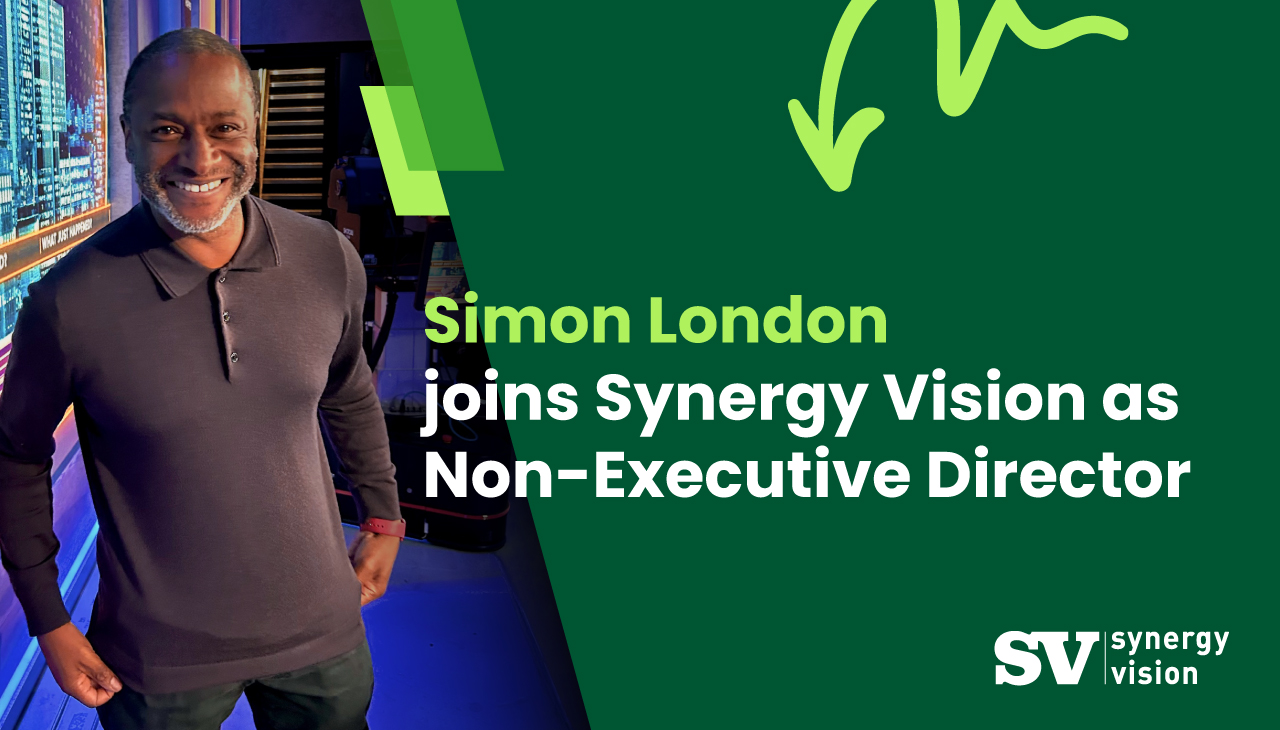
And that is one of many reasons we’re delighted to announce that Simon is joining Synergy Vision as a Non‑Executive Director in June, helping us become more agile as we navigate an increasingly uncertain biopharma landscape.
Leadership is marked by movement and flow
Simon’s career spans newspapers, live television, and production. In those environments, there’s no waiting to be ready. You have to make decisions in real time, often with no perfect answers, and the consequences of hesitating show up quickly.
“Strong leadership is making a decision in the moment,” says Simon, “so that you can keep moving forward with passion and confidence. And then if it’s wrong, you correct it. But you have to decide first.”
In medcomms, that can mean pivoting and scaling in a new therapy area when a pharma restructure hits. In the creative industries, deadlines arrive. Pages or airtime need to be filled. And sometimes, feeds go down.
“You have to be able to go, ‘right, we’ve lost the feed, put on some flamenco music’,” he recalls. “And then you might go, ‘that was a bad idea, put on an Irish jig instead’.”
“The point is that you make a decision, but don’t double down,” he adds. “You can acknowledge if you make a mistake, and people will understand.”
In a heavily governed industry like medcomms, this kind of approach might be misunderstood as risky. But more than ever, we need to be comfortable with ambiguity to avoid stagnation. Simon’s philosophy – that leadership comes from being willing to decide, adapt, and bring people along with you – is exactly what Synergy Vision needs.
Creativity is not a personality trait!
One of Simon’s most firmly held beliefs – the one he describes as the proverbial ‘hill I will die on’ – is for all the people who think science, data, and compliance can’t be paired with imagination.
“Everybody is creative. Everybody,” he stresses. “People will tell you they’re not. Really, they just need the confidence and the environment around them to be creative.”
This matters because many organisations – including in medcomms – unintentionally design creativity out of their systems, siloing it in specific roles and departments. When creativity gets treated like an add-on, done by specialists, rather than the core of every role that creates something and puts it into the world, innovation can feel brittle or performative. You can’t wait for inspiration to strike.
Simon’s approach as a leader is, instead, structural, deliberately and methodically engineering environments that activate ideas.
“Everybody on my team had to brainstorm every morning… the only caveat was that you had to come with three ideas,” he says.
Importantly, these sessions weren’t about judging the ‘best’ ideas. They sought to widen the surface area of thinking – pulling in perspectives from people who didn’t self‑identify as creative but absolutely were.
“That variety of perspectives will take you somewhere you didn’t know you were going to go,” Simon says.
For Synergy Vision, this lands directly at the intersection of creativity and governance. As we move forward and grow, creativity must become a shared responsibility – rigorous and process-based. But you can still call it ‘inspiration’ if you want to.
Moving Synergy Vision forward with an innovation mindset
One of the reasons Simon was drawn to Synergy Vision is precisely because of the constraints we operate under.
“I’ve had to come up with ideas before the watershed, or within a limited amount of time, or to suit different editorial objectives,” he says. “Coming up with solutions with quite strict governance around it… I could really see some synergy between what I’ve done and what Synergy Vision does.”
We can’t ignore compliance, regulations, and processes. So why not view them as defining the problem space, and then focus on creating meaning, clarity, and engagement within it?
This extends to Simon’s perspective on technology. He’s adapted through multiple technological inflection points and sees tools as accelerants, not creators.
“What we have to help people with is storytelling: the beginning, the middle, the end,” he says. “Technology can help you get there faster, but it can’t tell you what to imagine.”
That’s our role. We say Synergy Vision is ‘delivering the difference’. And that comes from the way we fuse lateral thinking with audience-first principles and seamless logistics to surprise and delight – and make life in biopharma easier. Simon’s experience and outlook will help ensure that we continue to imagine and improve what we do for ourselves and our clients every day.
What he sees in the SV crystal ball
Simon seeks to propel Synergy Vision’s next phase of growth at the intersection of creativity, governance, and leadership under real-world pressure.
“[At the end of my term], I would love if I had been able to help everybody come in and think maybe there’s a different way of doing stuff,” says Simon. “Just by questioning things from a different perspective, I hope it can have a lasting effect on how people work and make what you do better.”
We can’t wait for a future bolstered by Simon’s extra courage to examine assumptions, reframe problems, and invite better thinking into the room.